
FLOWERS IN MIXED MEDIA |
ÁINE DIVINE
wELCOME TO YOUR ONLINE TUTORIAL:
FLOWERS IN MIXED MEDIA WITH ÁINE DIVINE


Course FAQ
-
A Bold and Energetic Start: How to begin your painting with confidence and freedom, focusing on the big shapes and movement instead of getting stuck on small details.
Simple Colour Mixing: Easy techniques for mixing the colours you see, including how to soften bright colours to create beautiful, natural-looking tones.
Fun with Paint & Texture: How to use the unique properties of acrylic paint to create interesting effects, from dry-brush marks to lifting wet paint to bring back highlights.
Embracing Happy Accidents: Learn to use drips and runs to your advantage, making them a creative part of your artwork.
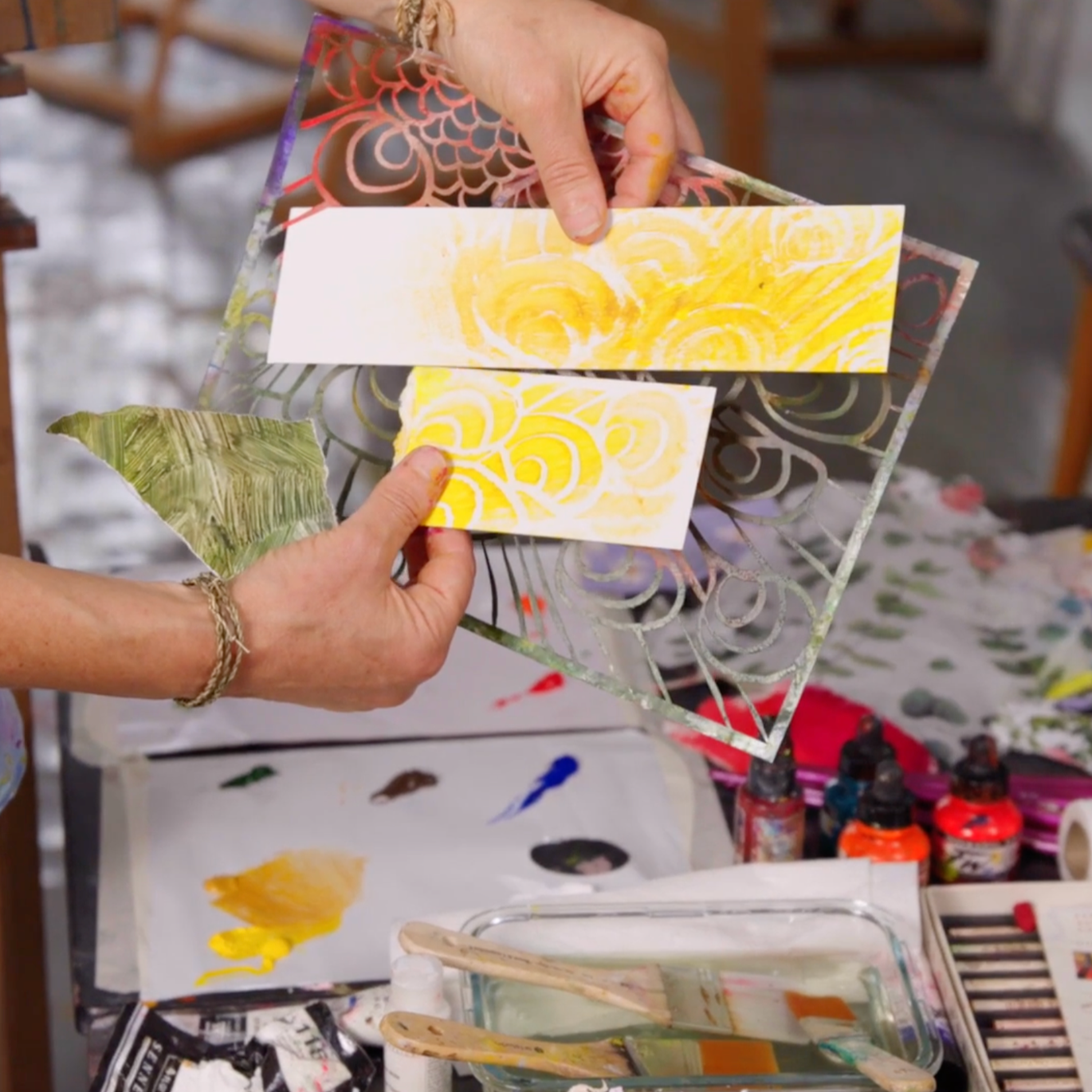
Easy Mixed-Media Techniques: Simple ways to combine different materials like stencils, collage, oil pastels, and inks for depth and detail.
Designing Your Painting: How to arrange elements to create a balanced composition, moving things around to make a better painting.
The Layering Process: A simple "add and subtract" method of building your painting by laying down colours and refining shapes.
Defining Flowers with Simple Shapes: Learn to see and paint the dark spaces between petals and leaves to make your flowers pop.
Creating Form with Light and Shadow: Mix simple grey and muted tones to show which petals are in shadow, giving your flowers a realistic feel.
Using "Character Marks": Learn easy tricks and signature marks that instantly make a flower look like a gerbera, daisy, or lily.
Making Final Decisions: How to assess your painting and make decisive moves to bring it to a satisfying finish.
Knowing When to Stop: How to find a "resolution" rather than perfection, leaving the painting feeling lively and complete.
-
Paints, Inks & Pastels
Acrylic Paints:
Cadmium Yellow
Yellow Ochre
Cadmium Orange
Cadmium Red
Magenta
Titanium White (Fluid Acrylic is also used)
Ultramarine Blue
Hooker's Green
Sap Green
Van Dyke Brown
High-Flow Acrylic Inks:
Fluorescent Red
Fluorescent Orange
Phthalo Turquoise
Oil Pastels: Sennelier brand (recommended for good coverage), including White, Orange, Red, Crimson, Yellow, and a dark Indigo/Black.
Indian Ink: In a small pot for drawing.
Brushes & Tools
Brushes (Royal & Langnickel "Burgundy" set recommended):
Wide, flat brushes (2-inch and 1-inch, including a slanted one)
Smaller round and flat brushes for detail
A 3-inch brush for covering large areas
Palette: Tear-off palette sheets.
Stencils: A variety of foliage and pattern stencils.
Adhesives: Pritt Stick (glue stick) and PVA (Wood) Glue.
Drawing Tool: A sharpened stick or the applicator from an old ink bottle for drawing with Indian ink.
Surfaces & Supports
Paper: Shirt Card (cardstock with a shiny side and a matte side; the shiny side is used for its manipulability).
Easel: An adjustable, upright easel.
Collage Materials
Papers: Torn pieces from old paintings, wrapping paper, patterned tissue paper (e.g., eucalyptus pattern), and pre-painted papers.
Card: For dipping into paint to create specific marks.
Additional Materials
Masking Tape
Water Container
Kitchen Paper / Paper Towels (white, to see colours clearly)
Spray Bottle (for water)
-
Suitable for all levels - good understanding of the basic use of watercolour would be an advantage.
-
The course is composed of three videos, a combined total of 98 mins. Enjoy the benefit of being able to watch and follow along at your leisure for the duration of your access.
-
FLOWERS IN MIXED MEDIA
-
Part 1: Flowers in Mixed Media
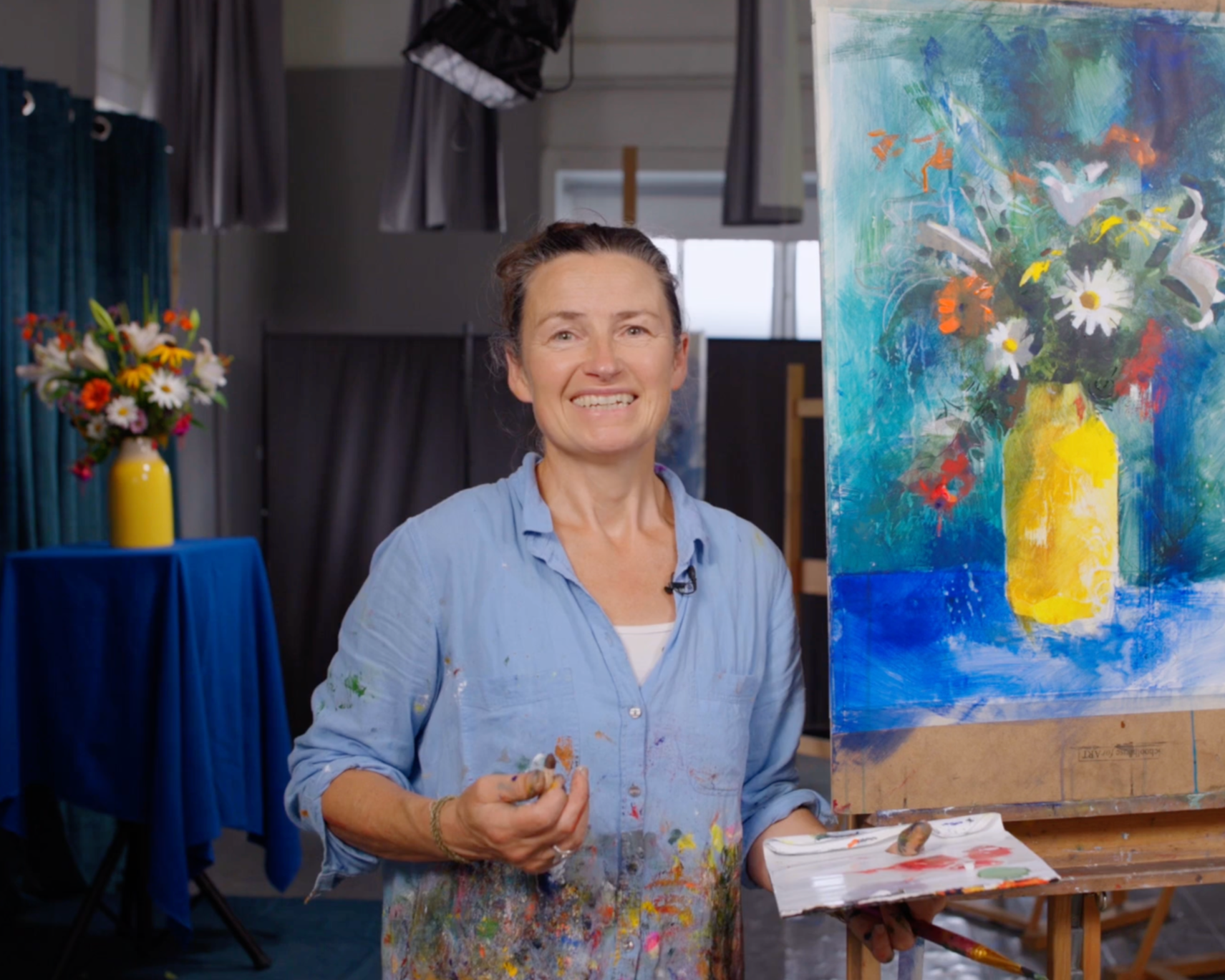
In this session, Áine Divine begins a dynamic mixed-media floral painting. She introduces her toolkit of acrylics, inks, and collage materials, then demonstrates her energetic process. Watch her establish the composition with bold strokes for the vase and tabletop, using a 'push and pull' method to shape the painting by lifting colour and embracing chance. She builds dark, textured foliage with stencils, creating a vibrant foundation for the detailed flowers to follow.
-
Part 2: Flowers in Mixed Media
In this video, watch the detailed modelling phase of a mixed media floral painting. You'll see how to define fuchsias, daisies, lilies, and gerberas by painting the dark negative spaces between petals, adding mid-tones for form, and using clever highlights. Áine demonstrates problem-solving in real-time, using background colours to carve out shapes and simple 'character marks' to make each flower type instantly recognisable, all while keeping the entire painting balanced and fresh.
-
Part 3: Flowers in Mixed Media
Watch the final session where Áine brings her mixed media floral painting to a satisfying resolution. Áine makes key decisions to finish the piece, adding bright oil pastel highlights to fuchsias, using stencils for greenery, and drawing fine details with Indian ink. You'll see problem-solving in real-time, using collage for petals and emphasising lights and darks to create a balanced, joyful composition that captures the essence of the flowers.
-